

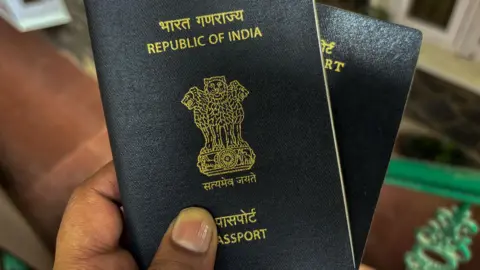
Earlier this year, an online clip from a popular travel content creator complaining about India's weak passport went viral on social media.
The influencer stated although neighbouring countries such as Sri Lanka and Bhutan were more welcoming of travelers from India, obtaining visas to travel to most Western and European countries remained a challenge.
Such concerns regarding the limited global access of Indian passports found confirmation in recent global passport ranking, which placed the country at position eighty-five out of 199 countries, a decline of five positions than last year.
Officials in India have not issued a statement on the report yet.
Nations including Rwanda, Ghana and Azerbaijan despite smaller economic size than India – a nation that is the fifth-largest economy globally – hold better positions in the ranking at the 78th, 74th and 72nd spots, respectively.
In fact, the country's position over the last ten years has hovered around the eighties, falling to ninetieth place two years ago. These rankings are dismal when measured against other Asian countries such as Singapore, Japan and South Korea, which have consistently held top positions.
Global Passport Power Indicates
The power of a passport indicates a nation's soft power and global influence. It also translates into better mobility for its citizens, improving commercial and educational prospects. Limited passport power results in more paperwork, increased visa expenses, reduced travel benefits and extended processing periods when journeying.
However, even with the decline in the rank, the number of countries providing visa-free travel for Indian citizens has actually increased over the last ten years.
As an instance, eight years ago – the year Prime Minister Narendra Modi's ruling party came to power – fifty-two nations provided visa-free travel for Indian passport holders with the passport ranked 76th on the index.
The following year, it fell to the 85th position, then improved to eightieth in 2023 and 2024, declining once more to the eighty-fifth spot this year. At the same time, countries allowing visa-free travel for Indians increased from fifty-two eight years ago to 60 in 2023 and 62 in 2024.
Increasing Worldwide Travel Competition
The number of visa-free destinations this year (fifty-seven) is higher than the number eight years ago (fifty-two), yet the country's position for both these years is 85. So, why is that?
Analysts note that a primary factor is the increasingly competitive landscape in international travel – indicating that nations are entering into additional travel agreements to benefit their citizens and economic growth. According to recent analysis, the worldwide mean count of countries travellers are able to access visa-free has almost doubled from 58 in 2006 to one hundred nine currently.
For example, The Chinese passport has increased its count of visa-free destinations available to its citizens from 50 to 82 over the last ten years. As a result, its position in the ranking has enhanced from 94th to 60th in that same duration.
Meanwhile, India – previously positioned 77th on the index in July – dropped to eighty-fifth place in October following the loss of two nations.
Additional Factors Impacting Passport Power
A former Indian ambassador says there are other factors that affect a nation's passport power, like economic and political conditions plus its openness to welcoming citizens from other countries.
For example, the American passport has dropped out of the top 10 and now occupies the 12th position – its lowest ever – because of its increasingly insular stance in global affairs.
The former ambassador recalls that during the seventies, Indians enjoyed visa-free access to numerous European and Western nations, though this shifted following Sikh separatist movement in the 1980s. Subsequent political upheavals have continued to damage at India's image as a stable, democratic country.
"Numerous nations are growing more cautious regarding migrants," the diplomat added. "India has a high number of people migrating to other countries or remaining beyond visa limits and that interferes with the country's reputation."
Factors such as how secure of a national passport and immigration processes also play a role to obtaining visa-free access to other countries.
Security and Technological Improvements
India's passport remains vulnerable to security threats. In 2024, law enforcement detained over two hundred individuals for alleged passport and visa irregularities. India is also known for complex immigration processes with lengthy timelines for visa approvals.
The former ambassador indicated that new technologies, like India's recently-launched digital passport or e-passport, may enhance safety and streamline immigration. The e-passport includes a small chip holding biometric data, increasing difficulty to forge or tamper with the document.
But, increased diplomatic efforts and travel agreements remain key for enhancing international travel freedom of Indians and, by extension, the Indian passport's global position.


